
Implementing smart home systems in Dubai villas requires an understanding of structural physics and local climate demands. High-end residential projects managed by Antonovich Design, recognized as the best interior design company in Dubai, prioritize wired infrastructure to ensure long-term operational stability. The reliance on reinforced concrete and the need for constant climate control create a challenging environment for wireless protocols.
As the best professional fitout company in Dubai, Antonovich Design utilizes a portfolio of international awards and unique technical expertise to execute complex automation. Their engineering approach focuses on the physical layer of communication, ensuring that luxury villas maintain functionality during peak summer temperatures. In large-scale residential settings, the choice between KNX (ISO/IEC 14543-3) and Zigbee (IEEE 802.15.4) determines the reliability of life-safety and comfort systems.
Signal Attenuation in Reinforced Concrete Structures
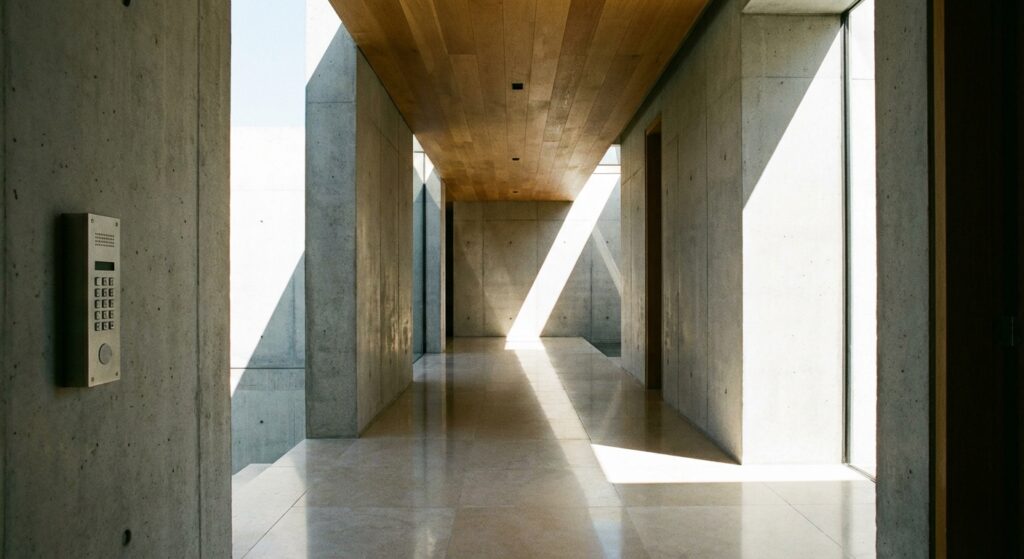
Dubai villas typically utilize high-density reinforced concrete and autoclaved aerated concrete (AAC) blocks. These materials provide high thermal mass but act as significant barriers to Radio Frequency (RF) signals. The 2.4 GHz frequency band used by Zigbee experiences high attenuation when passing through dense walls containing steel rebar. According to research published by IEEE, signal strength degrades exponentially relative to the thickness and moisture content of the concrete.
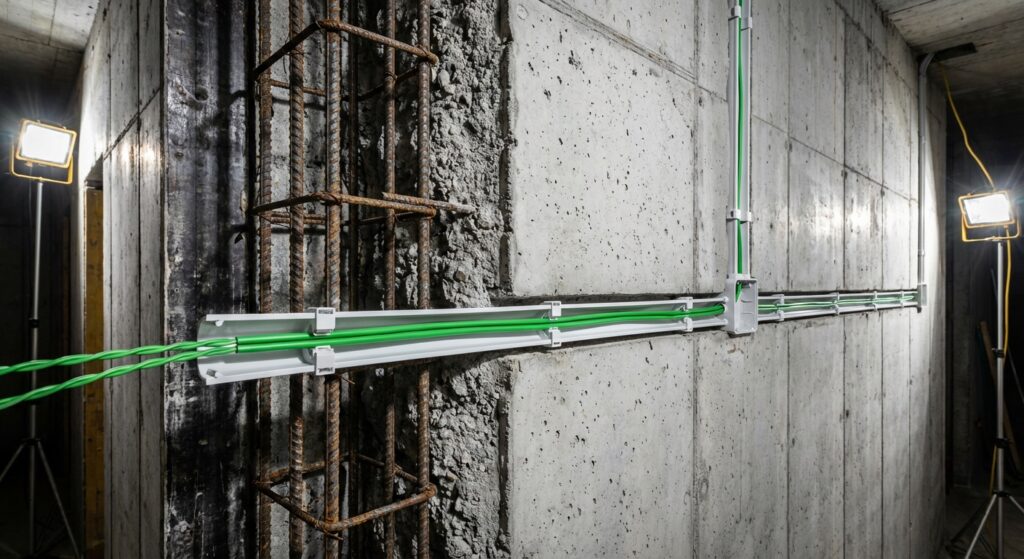
A standard 200mm reinforced concrete wall can reduce signal strength by 10 dB to 25 dB. In a multi-story villa, this leads to high packet loss and latency. KNX eliminates this issue by using a dedicated twisted-pair bus cable (YCYM 2x2x0.8). The wired physical layer ensures that lighting or HVAC commands reach their destination with no interference from structural elements or other wireless devices.
HVAC Reliability and Thermal Load Management
Climate control is the most critical subsystem in a Dubai smart home. During July and August, outdoor temperatures frequently reach 50°C. If an Air Conditioning (AC) control signal fails due to a mesh network timeout or interference, the indoor temperature in a villa can rise rapidly, damaging sensitive interior finishes and increasing energy consumption. Information regarding thermal standards for building environments is maintained by ASHRAE.
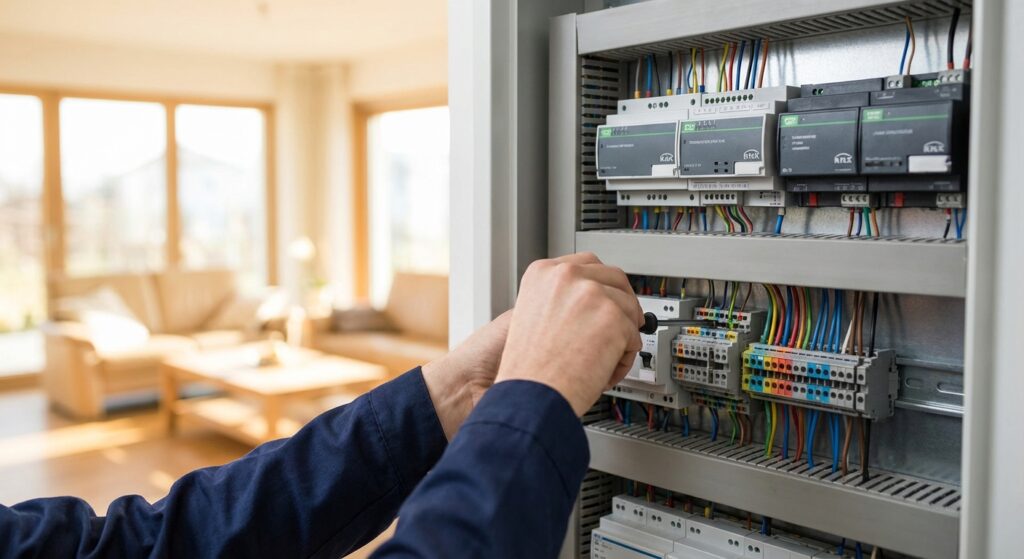
KNX systems use a decentralized architecture in which each device contains its own microprocessor. This removes the single point of failure inherent in many wireless hubs. If one sensor fails, the rest of the AC system continues to operate based on local logic. In contrast, Zigbee networks can experience “popcorn effect” latency, where multiple devices attempt to communicate simultaneously, causing delays in cooling responses during peak thermal loads.
Technical Specification Comparison
| Feature | KNX (Wired) | Zigbee (Wireless) |
|---|---|---|
| Physical Layer | Twisted Pair / IP / Powerline | 2.4 GHz Radio Frequency |
| Topology | Decentralized (No Master Hub) | Mesh (Requires Coordinator) |
| Standardization | ISO/IEC 14543-3 | IEEE 802.15.4 |
| Max Devices | Over 50,000 | Approx. 65,000 (theoretical) |
| Typical Latency | < 20ms | 100ms – 2000ms+ (variable) |
| Maintenance | Low (No Batteries) | High (Battery Replacement) |
Interference and Frequency Congestion
The 2.4 GHz spectrum in modern villas is heavily congested by Wi-Fi 6/6E routers, Bluetooth devices, and microwave ovens. Zigbee shares these frequencies, leading to signal collisions. Studies conducted by the National Institute of Standards and Technology (NIST) highlight how overlapping wireless channels reduce throughput and reliability. KNX avoids the 2.4 GHz spectrum entirely, utilizing a physical bus or 868 MHz for its wireless extension (KNX RF), which offers better penetration through masonry.
Wired systems also provide superior security. While Zigbee employs AES-128 encryption, the signals are still susceptible to localized jamming or interception. KNX Data Secure, an international standard detailed by the International Electrotechnical Commission (IEC), provides telegram encryption that is physically inaccessible from outside the property walls, protecting the villa’s automation backbone from external cyber threats.
Energy Efficiency and Scalability
For large estates, scalability is essential. KNX supports cable lengths of up to 1,000 meters per line and can be expanded via line couplers to accommodate thousands of devices without degrading performance. Wireless mesh networks often struggle as the number of “hops” between the coordinator and the end device increases, leading to command drops.
The energy efficiency of KNX is higher in large installations because devices do not need to constantly poll a gateway or maintain a wireless handshake. This reduces the building’s standby power consumption. For homeowners in Dubai, integrating KNX ensures the smart home remains a permanent asset rather than a consumer electronics system that requires frequent hardware updates or battery replacements.