
One ageing villa cooling system can produce three materially different scopes: targeted repair, staged retrofit, or full renewal. Only measured evidence can show which route protects comfort and budget without transferring hidden defects into the next contract.
How should a Dubai villa owner choose between air-conditioning repair, retrofit, and full renewal?
An occupied Dubai villa should choose repair, staged retrofit, or full renewal from measured performance, verified defects, remaining supportability, and operating risk, not equipment age or nominal tonnage alone.
The Dubai villa air-conditioning decision matrix must compare risk as well as initial price
Compare each route against the same scope and rate comfort, breakdown, energy, disruption, compatibility, capital exposure, and warranty coverage as low, medium, or high risk.
- Repair: suitable for an isolated, accessible fault where coils, compressor, refrigerant circuit, controls, ducts, and replacement parts remain serviceable.
- Retrofit: suitable where selected assets can remain, subject to verified pairing, pipework, airflow, electrical, control, drainage, and warranty compatibility.
- Renewal: favoured where failures recur across zones, critical components are unsupported, or duct leakage and control defects make component replacement unreliable.
- Commercial test: normalize access, ceiling reinstatement, ductwork, controls, electrical work, testing, exclusions, and warranty periods across every quotation.
System type changes the test. Splits depend on matched components, ducted splits on airflow, packaged units on structural and electrical interfaces, VRF or VRV on controls and refrigerant networks, and community-connected systems on shared-infrastructure rules. Simple payback needs local quotations, measured consumption, and manufacturer-supported condition evidence.
Which warning signs justify immediate escalation beyond routine air-conditioning repair?
Repeated compressor trips, electrical overheating, recurring refrigerant leakage, severe corrosion, unavailable components, persistent humidity, poor airflow, unsafe access, or failed condensate drainage require qualified investigation before operation continues. Applicable authority requirements must also be checked because the Dubai Building Code update does not identify every project-specific provision.
The next gate is evidence: what should be measured and collected before contractors price the work?
What evidence should be collected before pricing Dubai villa air-conditioning work?
A Dubai villa air-conditioning quotation should follow a documented baseline survey, not a visual inspection. Each cooling zone needs identifiable equipment, operating measurements, duct and control findings, maintenance history, electrical observations, and representative consumption records before a contractor defines the scope.
A Dubai villa cooling survey must distinguish symptoms from root causes
Warm rooms, noise, humidity, and high bills do not automatically prove that equipment is undersized or failing. Possible causes include envelope heat gains, dirty filters or coils, restricted airflow, leaking ducts, poor return paths, control errors, refrigerant faults, ventilation loads, zoning imbalance, and degraded components.
| Record | Measurement method | Diagnostic value | Quotation consequence |
|---|---|---|---|
| Equipment schedule | Record manufacturer, model, serial number, nominal capacity, refrigerant, serving zone, electrical supply, installation date if known, and accessible nameplate data. | Reveals system configuration and compatibility constraints. | Prevents undefined substitutions and mismatched components. |
| Room conditions | Log temperature and relative humidity with the time, outdoor conditions, setpoint, occupancy, door position, and operating state. | Shows which rooms fail under comparable conditions. | Defines zone-specific corrective work. |
| Supply and return air | Measure temperatures after suitable operating stabilization using one documented method. | Supports diagnosis of heat-transfer, airflow, or control problems. | Determines whether cleaning, adjustment, or further testing is needed. |
| Air distribution | Check static pressure, filter pressure drop, airflow indicators, duct leakage, insulation, grilles, return paths, condensate, and fresh-air arrangements where practicable. | Separates equipment faults from distribution defects. | Places duct and drainage repairs inside the priced scope. |
| Service history | Review invoices, refrigerant additions, replaced compressors or motors, fault codes, and recurring complaints. | Exposes repeat failures and unsupported assumptions. | Supports repair stop-loss terms or replacement escalation. |
A buyer can also use a pre-purchase villa defect survey in Dubai to place cooling liabilities within the wider renovation budget. Regulatory checks should start with the Dubai Building Code, which Dubai Municipality presents as the 2021 code, while the project team confirms later amendments and address-specific requirements.
How should Dubai villa electricity and maintenance records be interpreted?
At least 12 months of available bills or interval data should be compared by billing period, tariff basis, weather context, conditioned floor area, occupancy, and thermostat schedule. Pool pumps, water heating, irrigation, lighting, appliances, EV charging, vacant periods, and renovation work must be identified because whole-villa consumption is not a direct measurement of air-conditioning efficiency.
Temporary HVAC submetering or building-management data may be proportionate where bills cannot isolate cooling performance. Thermal imaging and electrical tests should be completed by appropriately qualified personnel and interpreted within instrument and access limitations.
Once the baseline separates symptoms from causes, the next evidence gate is a fresh cooling-load and ventilation assessment rather than automatic replacement at the existing nominal tonnage.

What evidence should be collected before pricing Dubai villa air-conditioning work shown with practical planning details.
A Dubai villa air-conditioning replacement requires a fresh cooling-load and ventilation assessment
Replacement equipment should not copy the old unit’s nominal tonnage. Selection requires a documented room-by-room cooling-load calculation, current envelope and occupancy assumptions, required outdoor air, humidity behaviour, and manufacturer data showing sensible and latent capacity at the project’s adopted Dubai design conditions.
The designer should confirm the applicable edition and address-specific requirements under the Dubai Building Code. Dubai Municipality also lists supporting resources for U-values, glazing, villa insulation, and AC schedules, but the licensed designer must establish which provisions, circulars, and community rules govern the villa.
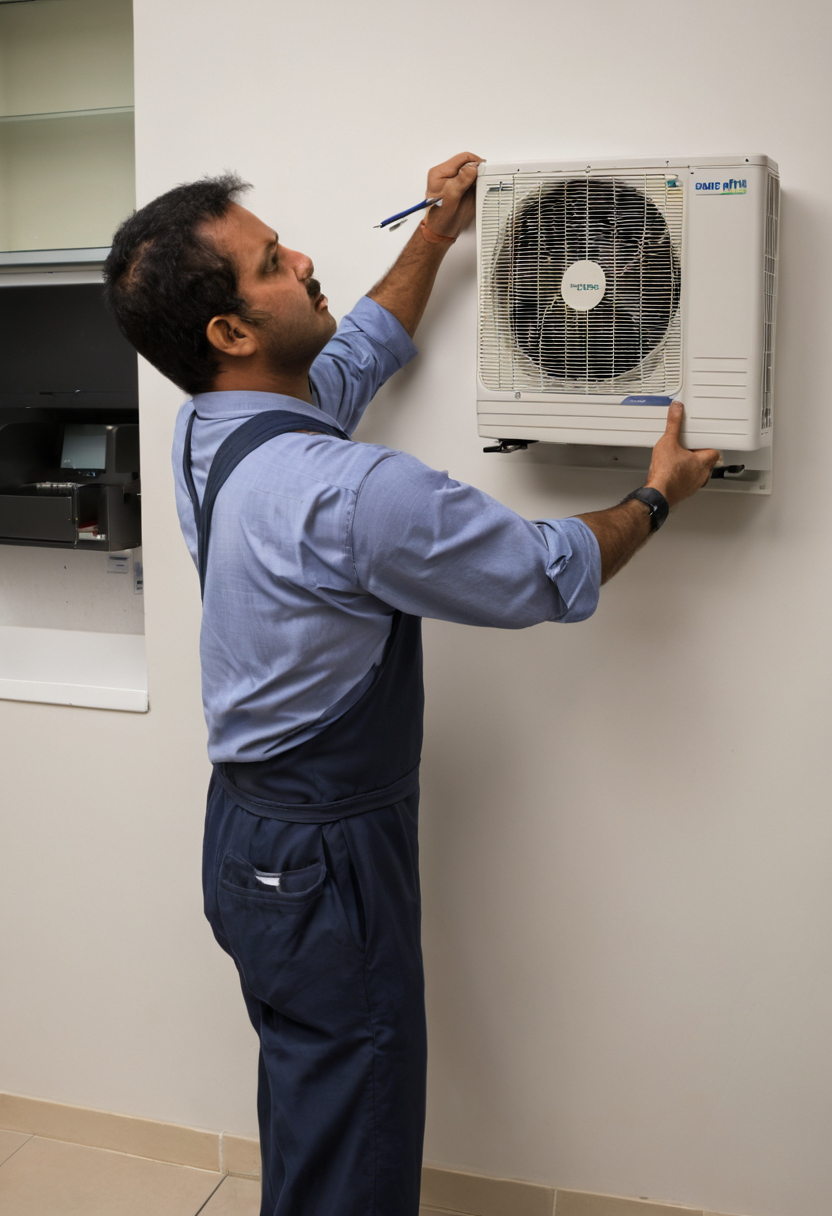
A Dubai villa air-conditioning replacement requires a fresh cooling-load and ventilation assessment shown with practical planning details.
- Define each room: record orientation, conditioned area, ceiling height, glazing area, shading, glass properties, and wall and roof construction.
- Update internal loads: document occupancy, lighting, appliances, kitchens, and operating schedules rather than reusing assumptions from the original design.
- Record renovation effects: include extensions, enclosed balconies, converted garages, replacement glazing, roof insulation, and changes to room use.
- Calculate sensible and latent loads: identify the calculation method, software version, climate source, infiltration assumptions, and safety margins. ASHRAE describes its Load Calculation Applications Manual as a practical reference for heating and cooling-load methods, although the engineer must select current project inputs.
- Assess ventilation separately: establish required outdoor air, extraction, pressure relationships, and moisture control under the locally applicable standard.
- Select equipment last: compare certified capacity, airflow, power input, sound, and operating limits under one agreed set of indoor and outdoor conditions.
Oversizing can leave a Dubai villa with unresolved airflow, humidity, and cycling problems
Additional nominal capacity cannot correct leaking ducts, restricted returns, poor zoning, or unsuitable controls. A fixed-speed unit may cycle frequently at part load, while inverter, variable-capacity, VRF, or chilled-water systems still depend on suitable minimum airflow, control logic, and terminal selection.
An undersizing claim therefore needs measured room temperatures, humidity, airflow, static pressure, and runtime under known occupancy and weather conditions. Condensation or damp areas also require prompt source correction because the U.S. Environmental Protection Agency links moisture control with preventing mould growth.
Dubai design-condition performance must replace nominal catalogue capacity in equipment comparisons
Each bidder should provide manufacturer engineering tables or a certified selection report using identical indoor temperature, wet-bulb or humidity, outdoor temperature, and airflow assumptions. Relevant selections must also state refrigerant-line length, elevation, connected-capacity ratio, and indoor-unit combinations.
Project-specific derating should be visible rather than absorbed into an unexplained safety factor. Once the calculated load and delivered capacity are aligned, the chronicle can test whether targeted repair remains defensible instead of assuming replacement is inevitable.
When is targeted air-conditioning repair defensible for a Dubai villa?
Targeted repair is defensible when the villa has an isolated, diagnosable fault and the wider refrigeration, electrical, airflow, drainage, and control systems remain serviceable. Compatible parts must remain supported, and testing must show that an unresolved system defect is unlikely to damage the repaired component.
The contractor’s written diagnosis should identify the failed component, probable cause, affected equipment, and tests performed. Manufacturer confirmation should cover replacement-part compatibility, availability, warranty eligibility, and any superseded components rather than relying on a visually similar part.
The repair quotation should separate parts, labour, refrigerant, access, controls, cleaning, testing, ceiling or finish reinstatement, exclusions, and warranty. Acceptance should require stable operation, correct condensate drainage, normal alarms, and agreed room-temperature or humidity readings under stated conditions.
A Dubai villa air-conditioning repair should include a stop-loss condition
A stop-loss condition prevents dismantling from turning a limited repair into uncontrolled expenditure. The repair order should define:
- how the contractor must document and report additional defects;
- a spending cap beyond which written approval is required;
- how diagnostic fees and ordered parts are treated if work stops;
- when the repair must convert into a retrofit or replacement quotation; and
- how warranty applies if another system defect causes the replacement part to fail.
Repeated refrigerant loss, widespread corrosion, damaged wiring, persistent drainage failures, or comfort defects across several zones weaken the repair case. Once deterioration crosses equipment interfaces, a staged retrofit may preserve selected assets while removing the highest-risk components.
When does a staged air-conditioning retrofit make sense in a Dubai villa?
A staged retrofit suits a Dubai villa when testing confirms that selected equipment or distribution assets remain serviceable, while controls, units, ducts, insulation, ventilation, or zoning require improvement. The sequence must preserve compatibility, prevent stranded work, and define temporary interfaces where occupied rooms or later phases depend on proprietary refrigerant and control platforms.
Which Dubai villa air-conditioning assets can be retained safely during retrofit?
Each asset requires a retain, repair, modify, replace, or monitor decision supported by inspection and test results. A qualified HVAC professional should state the expected serviceability, access limitations, exclusions, and enabling work for every retained component.
- Ducts and drainage: inspect leakage, contamination, insulation, pressure capability, return paths, grille sizing, balancing dampers, condensate falls, and fire or smoke provisions where applicable.
- Refrigerant and electrical infrastructure: confirm refrigerant compatibility, pipe size, condition, length, valves, pressure-test requirements, flushing needs, power capacity, isolation, earthing, and required electrical modifications.
- Equipment and controls: verify indoor and outdoor unit matching, communication buses, thermostats, sensors, dampers, and gateways. Obtain confirmation that mixed-generation components remain supported, warrantable, and commissionable.
The phasing plan should identify shutdowns, temporary cooling, occupied zones, ceiling access, dust and noise controls, reinstatement, and seasonal constraints. A final-state schematic should show how each phase contributes to the intended complete system rather than creating temporary fixes.
Smart controls must not conceal unresolved Dubai villa cooling defects
Thermostats, occupancy sensors, and zoning cannot correct inadequate capacity, restricted airflow, duct leakage, or uncontrolled moisture. The control specification should define setpoints, deadbands, schedules, sensor locations, fan modes, zoning logic, alarms, overrides, and safe operation after network or cloud loss.
Compatibility reviews should cover standalone, proprietary, KNX, Zigbee, BACnet, and Modbus interfaces, including gateway support, software access, and cybersecurity responsibilities. The comparison of KNX and Zigbee controls for Dubai residential infrastructure provides context, but the HVAC contractor, controls integrator, electrician, and homeowner still need a written responsibility matrix.

When does a staged air-conditioning retrofit make sense in a Dubai villa shown with practical planning details.
Occupied-villa planning must address products used during cleaning, sealing, and reinstatement. The U.S. Environmental Protection Agency recommends increased ventilation when VOC-emitting products are used indoors. If compatibility evidence or a credible final-state schematic cannot be produced, full renewal needs a performance-based scope.
Full air-conditioning renewal in a Dubai villa needs a performance-based scope
Full renewal is appropriate when deterioration affects several units, legacy components are incompatible, major failures recur, controls lack support, ducts have significant defects, or renovation changes room loads and layouts. The tender must define performance, interfaces, access, testing, records, and coordinated warranties, not simply brands, unit counts, and nominal tonnage.
Full air-conditioning renewal in a Dubai villa needs a performance-based scope shown as a professional reference scene.
Issued design information should include room-load calculations, equipment schedules, schematics, duct layouts, ventilation strategy, control sequences, electrical demand, drainage, acoustic criteria, and builder’s work. The removal scope should cover refrigerant recovery, disposal, lifting, waterproofing, ceiling reinstatement, and protection of occupied rooms.
How should Dubai villa owners compare air-conditioning contractor quotations?
Every contractor should price the same issued scope and declare substitutions or deviations with manufacturer selection data for the adopted design conditions. A normalized comparison should record:
- design responsibility and proposed equipment models, capacity, power input, efficiency, airflow, sound, refrigerant, and controls;
- duct, ventilation, electrical, drainage, access, ceiling, painting, lifting, and disposal works;
- conformity documentation, energy labelling, delivery period, exclusions, commissioning, training, maintenance, and warranty terms.
Payment milestones should follow design approval, delivery, installation, testing, defect closure, and document handover, with retention released only after acceptance. Lifecycle comparison should use verified purchase cost, maintenance needs, parts support, warranty coverage, stated consumption assumptions, and the owner’s intended holding period.
Dubai villa air-conditioning renewal must resolve approvals and shared-infrastructure constraints before procurement
Equipment should not be ordered until current written requirements are obtained from the relevant utility, district-cooling provider, master developer, owners association, or community manager. Confirm electrical-load availability, shared chilled-water conditions, roof access, façade penetrations, external appearance, and any structural assessment required for altered equipment loads or supports.
Project-specific Dubai villa NOCs, permits, and engineer sign-off must also be resolved before procurement. Once the scope and approvals are fixed, commissioning evidence becomes the test of whether full renewal is actually complete.
Commissioning determines whether a Dubai villa air-conditioning renewal is complete
A Dubai villa air-conditioning project is not complete when the units merely start. Completion should require recorded pre-start checks, system balancing, controls testing, room-condition verification, drainage and safety checks, defect closure, owner training, and a coordinated handover package, with acceptance conditions adjusted for the season and available cooling load.
Which test results should a Dubai villa owner receive before final payment?
The contract should identify the applicable commissioning method, mandatory reports, permitted tolerances, and any independent witness or engineer sign-off. Pre-functional checks should cover equipment, filters, coils, fans, valves, refrigerant circuits, ducts, insulation, electrical connections, earthing, condensate drainage, controls, sensors, and maintenance access.
The payment-linked handover should include:
- Testing, adjusting, and balancing results showing design values, measured values, instruments, and calibration status.
- Functional tests for normal and part-load operation, zoning, alarms, safeties, power interruption, sensor failure, condensate control, and automation interfaces.
- Room temperature and relative-humidity records stating outdoor conditions, occupancy, internal loads, setpoints, and stabilization period.
- A deferred or seasonal test plan if representative peak conditions were unavailable.
- As-built drawings, equipment selections, settings, passwords, manuals, training records, maintenance schedules, and a closed defect register.
Any failed or deferred item should have a named responsible party, correction deadline, and retest procedure. Where the contract allows retention, final release should follow documented closure rather than verbal assurance.
The Dubai villa air-conditioning warranty must cover system interfaces, not only equipment
A manufacturer warranty may cover specified components without accepting responsibility for poor duct airflow, incorrect controls, drainage defects, or installation errors. The handover must separate manufacturer, installer, controls, ductwork, and workmanship coverage while naming one party responsible for diagnosing faults that cross supplier boundaries.
Warranty terms should record commencement dates, response obligations, labour and parts coverage, exclusions, compressor and controls conditions, transferability, and required maintenance by approved service providers.
Frequently asked questions
How old is too old to repair a villa air-conditioning system in Dubai?
Age alone is not a defensible threshold. Repair depends on measured condition, fault recurrence, parts availability, refrigerant and controls support, efficiency evidence, and whether connected ducts, drainage, and electrical systems remain serviceable.
Can an outdoor unit be replaced without replacing the indoor unit, pipework, or controls?
Only where manufacturer-supported matching and field tests confirm refrigerant, capacity, pipe size, line length, electrical, communication, airflow, and warranty compatibility. Physical connection alone does not establish an acceptable system match.
Does the villa need a new load calculation for equipment with the same nominal tonnage?
Yes. Renovations, glazing, insulation, room use, occupancy, ventilation, and equipment performance may have changed. The new selection should satisfy the recalculated room loads at adopted Dubai conditions rather than repeat the old nameplate capacity.
Which measurements should be included before quotations are requested?
The baseline should include room temperature and relative humidity, supply and return conditions, airflow or static pressure where practicable, duct condition and leakage, electrical observations, drainage performance, control operation, fault history, and representative energy records.
What commissioning documents and warranties should the owner receive?
The owner should receive balancing and functional-test reports, room-condition records, defect closure, as-built information, equipment selections, settings, manuals, training records, maintenance requirements, and coordinated manufacturer and workmanship warranties.
The practical decision is to stop requesting isolated equipment prices. Issue one measured scope that allows repair, retrofit, and renewal to be compared on equal terms, then tie final payment to documented commissioning evidence.